Take a moment to look at your phone camera. Or simply glance out the window. That simple act—seeing an image of the world—is something humanity fundamentally misunderstood for thousands of years. It took a man sitting alone in a dark prison cell, afraid for his life, to finally figure it out.
His name was Ibn al-Haytham (known in the West as Alhazen), and his life story isn't just about dry science. It is a thriller about arrogance, a mad king, a fake mental illness, and a discovery that changed the world forever. He didn't just find the truth; he invented the way we find truth.
The Ambitious Clerk of Basra
Our story begins in Basra, modern-day Iraq, around 965 AD. This was the Golden Age of Islam, a time when libraries were more valuable than banks, and scholars were the true celebrities of society.
Young Ibn al-Haytham was brilliant, but he was also deeply frustrated. He spent his days working a comfortable government job as a civil servant, but his nights were spent devouring books. He read the ancient Greek masters—Aristotle, Euclid, Ptolemy—and he noticed something troubling. The greats were constantly arguing with each other. One said the universe worked one way; another said the opposite.
He wanted certainty. He famously wrote, "I constantly sought knowledge and truth, and it became my belief that for gaining access to the effulgence and closeness to God, there is no better way than that of searching for truth and knowledge."
But his ambition was too big for his desk. He looked at the mighty Nile River in Egypt—a river that flooded unpredictably, destroying crops and causing famines—and he had an idea. A very dangerous, arrogant idea.
The Fatal Boast
"I can tame the Nile," he boasted to anyone who would listen.
He claimed he could build a dam that would regulate the waters, saving Egypt from starvation and drought forever. This bold claim traveled across the desert, all the way to the ears of the Fatimid Caliph in Cairo, al-Hakim.
Now, al-Hakim was not a normal boss. History remembers him as the "Mad Caliph." He was brilliant but violently unstable. Legend says he once banned women from making shoes so they couldn't leave their houses, and ordered the killing of all dogs because their barking annoyed him. When he heard Ibn al-Haytham’s pitch, he summoned the scholar immediately.
Ibn al-Haytham traveled to Egypt, treated like royalty and funded by the Caliph's gold. He marched south to Aswan to survey the site. He stood on the banks, looking at the rushing water, the sheer width of the river, and the primitive tools of his time.
His heart sank. With the technology of the 11th century, it was impossible. He had promised something he couldn't deliver.
He realized with terrifying clarity: If I tell the Caliph I failed, he will kill me.
The Great Pretence
Returning to Cairo, Ibn al-Haytham had to think fast. You didn't just resign from al-Hakim's service. You escaped or you died.
So, he decided to play the role of a lifetime. He feigned madness.
He stopped speaking coherently. He acted erratically in public. He let his appearance go. The court whispers began: the great scholar had lost his mind under the pressure. The Caliph, perhaps amused or perhaps deciding a crazy man wasn't a threat worth executing, stripped him of his titles and placed him under house arrest.
It was a mercy, but it was also a prison. For ten long years, Ibn al-Haytham was locked in his home. He was cut off from the world. He was alone. But this imprisonment turned out to be a blessing in disguise. With nothing but time and solitude, he turned his room into a laboratory.
The Dark Room Discovery
Trapped in his room, he began to obsess over light. At the time, the smartest people in the world believed in the Emission Theory—the idea that our eyes shot out laser beams that scanned the world like a flashlight.
Ibn al-Haytham sat in the dark and thought, "That doesn't make sense. If my eyes shoot light, why does it hurt to look at the sun? Why can't I see in the dark? The light must be coming in, not going out."
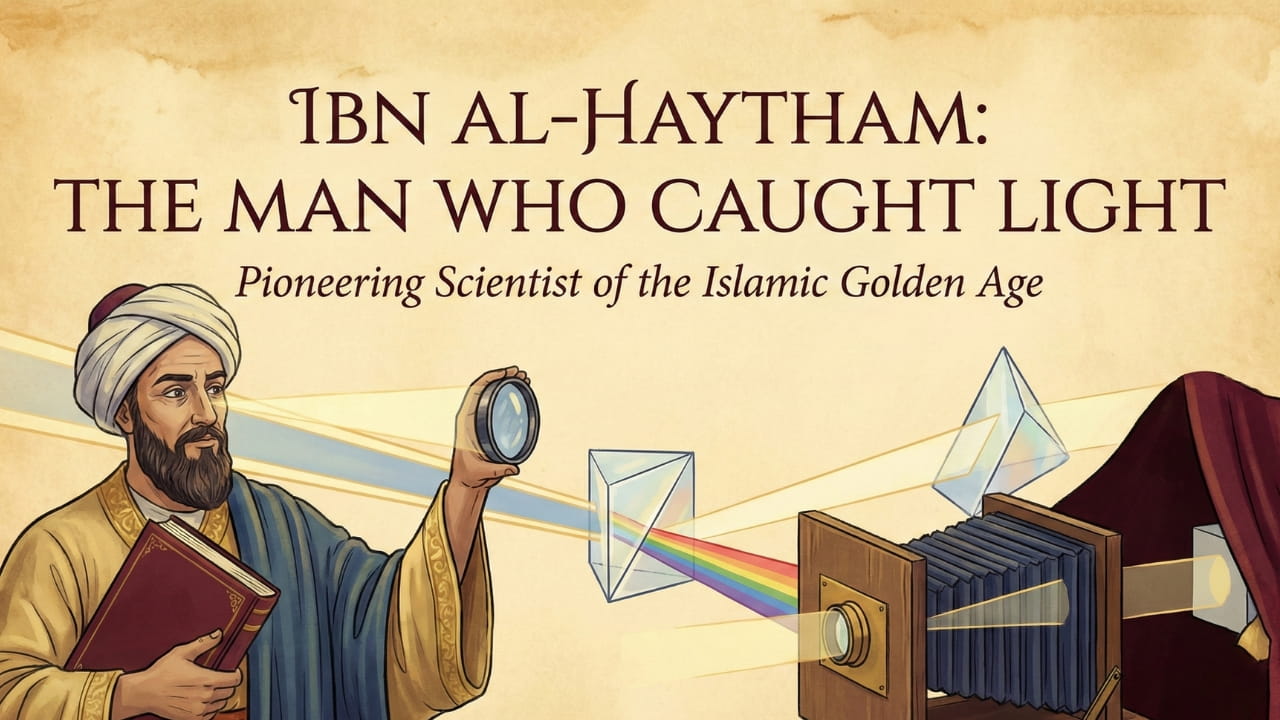
One sunny afternoon, he noticed something strange. A tiny pinhole in his window shutter let in a single ray of light. On the opposite wall of his dark room, an image appeared. It was the street outside—people walking, carts moving—but everything was upside down.
He stared at it. He had discovered the principle of the Camera Obscura (Latin for "Dark Room").
He realized that light travels in straight lines. It bounces off objects, passes through the pupil, and projects an image onto the back of the eye. He wasn't just a prisoner anymore; he was the first man in history to truly understand how we see the universe.
The Birth of the Scientific Method
During those lonely years, he wrote his masterpiece, Kitab al-Manazir (The Book of Optics). But he did something even more important than correcting the Greeks regarding vision. He changed how we do science.
Before him, science was mostly philosophy—people sitting around arguing about what "should" happen based on logic. Ibn al-Haytham said, "No. We must prove it."
He introduced the concept of the Scientific Method: Observe, Hypothesize, Experiment, and Verify. He argued that we must be skeptical of our own ideas. He wrote words that every modern thinker should live by:
"The seeker of truth is not he who studies the writings of the ancients and, following his natural disposition, puts his trust in them... but rather the one who suspects his faith in them, the one who submits what he reads to argument and demonstration."
Freedom and Legacy
In 1021 AD, the Mad Caliph vanished during a night walk (likely assassinated). Ibn al-Haytham miraculously "recovered" his sanity and was released. He spent the rest of his life teaching and writing, living simply by copying manuscripts to earn his bread.
He died around 1040 AD in Cairo at the age of 74.
His legacy is immense. Without him, we might not have cameras, telescopes, or microscopes. Isaac Newton, Leonardo da Vinci, and Galileo all studied his work. Every time you snap a photo with your phone, you are using the physics discovered by a man hiding for his life in a dark room in Cairo.
What We Can Learn From His Life
- Constraints Can Be Gifts: Ibn al-Haytham was imprisoned for a decade. He could have given up or gone mad for real. Instead, he used that darkness to understand light. Your current limitations might be the exact environment you need to focus on your masterpiece.
- Question Everything: Don't accept something just because an "expert" or a celebrity said it. Test it. Verify it. Think for yourself.
- Survival Requires Creativity: Sometimes, the smartest move isn't to fight the Caliph, but to outsmart the situation. Adaptation is the highest form of intelligence.