Imagine trying to measure the exact size of the entire planet. Now, imagine doing it without a single satellite, without a computer, and without even leaving your country. You have no GPS, no calculator, and no lasers. All you have is a wooden stick, a brass instrument, and a mountain.
It sounds like an impossible riddle, but over 1,000 years ago, a man named Abu Rayhan al-Biruni solved it. He calculated the circumference of the Earth with a staggering 99.7% accuracy compared to our modern measurements.
But Al-Biruni wasn't just a mathematician. He was a refugee, a wanderer, and a genius who lived in the chaotic heart of war zones. While armies fought over land, he fought against ignorance. He became the world's first true anthropologist, bridging cultures that hated each other, all while proving that the pen really is mightier than the sword.
The Scholar Born in a Storm
Al-Biruni was born in 973 AD in Khwarezm (modern-day Uzbekistan). From the moment he took his first breath, his life was unstable. He grew up during a time when dynasties rose and fell like tides.
While other young men in his village were learning to fight with swords or trade in the markets, Al-Biruni was fighting to learn. He was insatiably curious. By his early twenties, he was already famous locally for his deep knowledge of astronomy, physics, and history. But knowledge offers little protection against a sword.
When he was 23, a civil war erupted in his homeland. The royal family he served was overthrown and massacred. Al-Biruni was forced to flee for his life.
For years, he lived as a wanderer. He moved from city to city, seeking patronage from kings and sultans, offering his mind in exchange for safety. It was a dangerous game. In those days, a scholar was a status symbol for a king, but one wrong word could mean death. Al-Biruni had to be as diplomatic as he was brilliant.
The Hostage of the Conqueror
His travels eventually put him on a collision course with one of history’s most formidable conquerors: Sultan Mahmud of Ghazni.
Mahmud was a warrior king who built a massive empire in what is now Afghanistan. When Mahmud conquered Al-Biruni’s region, he didn't kill the famous scholar. He took him.
Al-Biruni was brought back to the capital city of Ghazni effectively as a "prized collectible." He was part court astrologer, part hostage. It was a tense relationship. The Sultan was a man of the sword with a short temper; Al-Biruni was a man of logic who despised superstition. Yet, Al-Biruni survived by making himself indispensable.
This forced relocation, however, opened a door that would change history. The Sultan launched a massive invasion of India. And he took Al-Biruni with him.
The First Anthropologist
This is where Al-Biruni proved he was different from any scholar before him.
Most conquerors look at a new land and see only what they can take—gold, slaves, spices, or land. They view the locals as enemies or inferiors. Al-Biruni looked at India and saw something more valuable: Knowledge.
While the army camped, Al-Biruni slipped away. He didn't just observe the Indians; he immersed himself in their world. He spent years learning Sanskrit, a notoriously difficult language for outsiders. He read the ancient Hindu texts on astronomy, mathematics, and philosophy. He sat with Brahmin priests and scholars, treating them not as conquered subjects, but as peers and teachers.
He compiled his findings into a massive book called Tarikh al-Hind (The History of India). In it, he did something revolutionary: he described Indian culture, religion, and science objectively. He didn't mock their beliefs or judge them as "wrong" just because they were different from his own Islamic faith.
He famously wrote: "I shall not produce the arguments of our antagonists in order to refute such of them as I believe to be erroneous. My sole object is to bring together the materials..."
This was unheard of. In a time of religious war, Al-Biruni invented anthropology—the study of human societies—simply by listening instead of judging.
The Mountain and the Impossible Math
While in India, Al-Biruni became obsessed with a question that had puzzled scholars for centuries: How big is the Earth?
The ancient Greeks had calculated it before, but their method was grueling. It required two men to walk hundreds of miles in a perfectly straight line across a flat desert, measuring every step. In the war-torn mountains of Punjab, this was impossible. Al-Biruni couldn't walk a straight line without walking off a cliff or into an enemy patrol.
So, he decided to use his brain instead of his feet. He devised a brilliant new method using trigonometry.
He found a lonely, tall mountain near the Nandana Fort. First, he had to measure the height of the mountain. He did this by measuring angles from two different points on the ground—basic geometry.
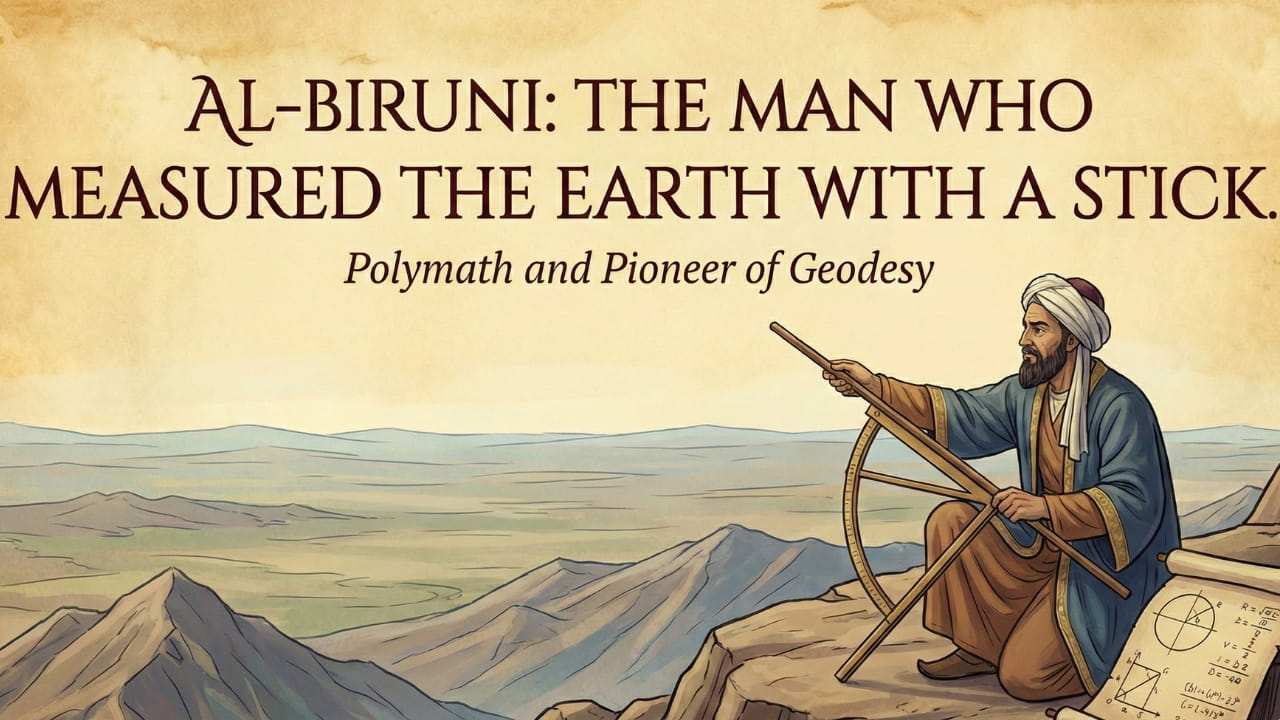
Then came the genius part. He climbed to the very peak of the mountain. The wind whipped at his robes as he held up a large brass astrolabe (a measuring instrument). He looked out at the flat horizon where the sky met the earth.
Because the Earth is curved, the horizon looks slightly lower when you are high up. Al-Biruni carefully measured the tiny angle between his eye level and the dip of the horizon.
That was it. That was all he needed. One mountain, one angle.
He sat down, dipped his quill in ink, and ran the numbers. Using the height of the mountain and that single angle of the dip, he calculated the radius of the Earth.
The Result? He calculated the radius to be 6,335.725 km.
The Reality? Modern satellites tell us the actual radius of the Earth is approximately 6,371 km.
He was off by less than 1%. He achieved this in the 11th century, in the middle of a military campaign, without a calculator, a telescope, or a computer. He effectively measured the world with a stick.
Legacy of the Master
Al-Biruni died around 1048 AD in Ghazni. By the end of his life, he had written over 140 books covering everything from gems and drugs to history, geography, and astronomy. He even argued that the Earth spins on its axis, centuries before Galileo faced trial for the same idea.
He lived in a time of sword and shield, yet he fought his battles with pen and paper. He showed the world that science has no religion, no borders, and no master but the truth.
"The scientific method is the only way to distinguish the truth from the false." — Al-Biruni
Key Lessons for Modern Thinkers
- Curiosity Over Prejudice: When Al-Biruni went to India, he didn't judge; he learned. By keeping an open mind, he accessed wisdom that others ignored. In a polarized world, curiosity is your greatest asset.
- Resourcefulness is a Superpower: He couldn't use the standard method to measure the Earth, so he invented a new one. If you can't do it the "normal" way, don't give up—use your brain to find a better way.
- Objectivity Matters: He valued the truth above all else, even if it contradicted popular belief or his own bias. Being an objective observer is the mark of true intelligence.