On November 30, 2022, the world changed. It didn't happen with a bang, a massive press conference, or a flashy TV commercial. It happened quietly, with a simple, empty text box on a white screen. When OpenAI released ChatGPT to the public, they expected a quiet "research preview" for a few thousand nerds. Instead, they got the fastest-growing consumer application in human history.
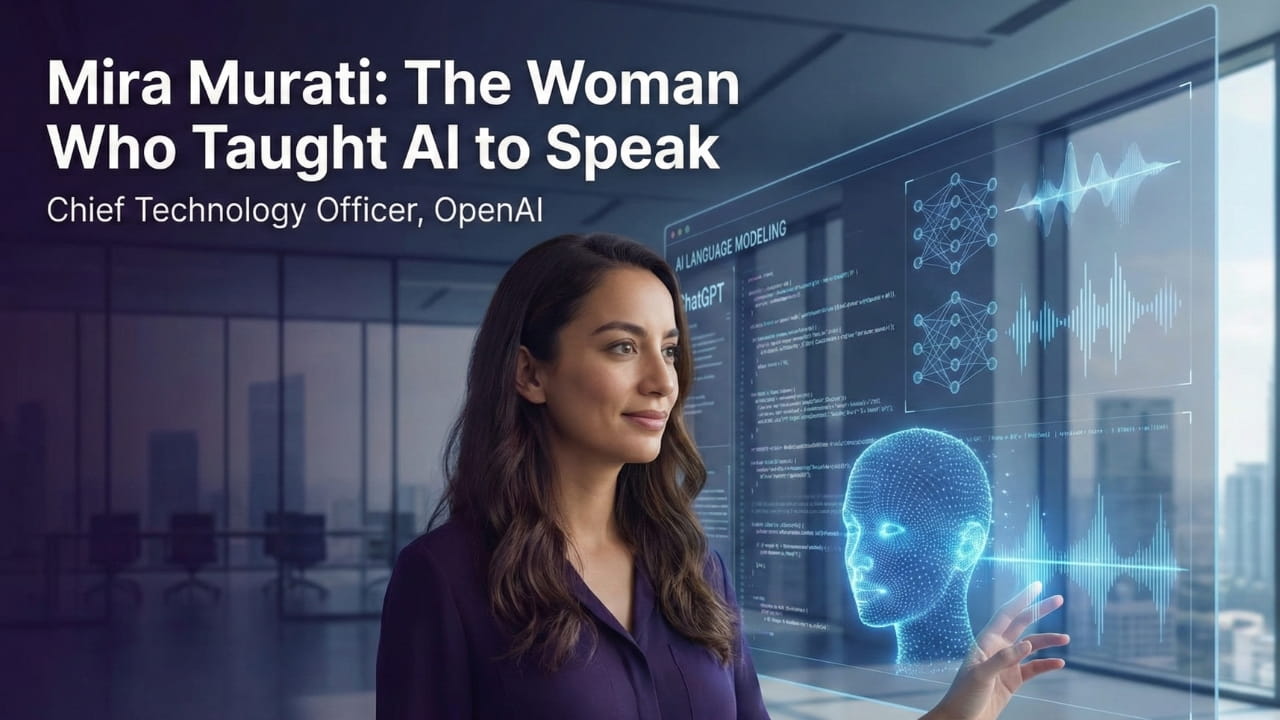
Suddenly, computers weren't just calculating numbers; they were writing poetry, debugging code, planning vacations, and cracking jokes. While CEO Sam Altman became the public face of this revolution, appearing on magazine covers and testifying before Congress, the mind orchestrating the machinery was someone much quieter.
Her name is Mira Murati.
In a Silicon Valley culture dominated by loud personalities and aggressive "move fast and break things" mantras, Murati is a refreshing anomaly. She is calm, soft-spoken, and intensely philosophical. She quotes the poet Rainer Maria Rilke as often as she discusses neural networks. Her journey—from a childhood in post-communist Albania to the cockpit of the most powerful AI company on Earth—is a masterclass in curiosity, resilience, and the relentless pursuit of "how things work."
Growing Up in the Shadow of Chaos
To understand Mira Murati, you have to understand where she started. She was born in 1988 in Vlorë, Albania. Her childhood wasn't filled with the latest gadgets or stable internet. It coincided with the collapse of the communist regime and the turbulent, often violent transition to democracy in the Balkans.
The world outside her window was unpredictable. Institutions were crumbling, and the future was uncertain. In the midst of this chaos, young Mira found a sanctuary where the rules never changed: Mathematics.
She fell in love with the logic of numbers. She loved that 2 plus 2 always equaled 4, no matter who was in charge of the government or what was happening on the streets. But she wasn't just a math whiz; she was deeply creative. She devoured literature, fascinated by the human imagination. This dual love—for the rigid logic of machines and the fluid creativity of humans—would become the defining theme of her life.
At 16, she realized she had outgrown her surroundings. She applied for and won a scholarship to the prestigious Pearson College UWC in Vancouver, Canada. It was a brave leap. She left her family, her language, and her culture behind to chase a future she couldn't yet see, flying halfway across the world alone.
The Engineer Who Loved Cars
She eventually landed at Dartmouth College, an Ivy League university in the US, where she studied mechanical engineering. But Mira wasn't interested in just passing exams or writing papers. She wanted to get her hands dirty. For her senior project, she didn't write a thesis; she built a hybrid race car.
After graduation, she didn't take a safe corporate job at a bank or a consulting firm. She joined a company that was trying to do the impossible: Tesla.
At Tesla, she worked on the Model X. Specifically, she was a senior product manager tasked with one of the most notoriously difficult engineering challenges in automotive history: the "Falcon Wing" doors.
It was an engineering nightmare. The doors had to open upwards, avoiding low garage ceilings while detecting obstacles like fingers or other cars. They needed complex sensors, silent motors, and perfect geometry. If the software failed, the hardware would crush something.
This was Murati’s crucible. She spent countless hours on the factory floor, bridging the gap between Elon Musk’s wild vision and the hard laws of physics. It was here that she learned her most valuable lesson: Technology is useless if it doesn't work for humans. It doesn't matter how advanced the AI is if the door doesn't open when you have groceries in your hands.
The Leap to the Mind
But eventually, she realized that hardware had its limits. You can only move atoms so fast. Murati wanted to move ideas. She wanted to work on the ultimate machine: the mind.
She moved to Leap Motion, a company working on hand-tracking technology for virtual reality. She wanted to replace the keyboard and mouse with natural hand gestures—allowing people to "touch" the digital world. But she hit a wall.
The hardware was great, but the computer didn't "understand" what the user wanted. It was just tracking movement, not intent. She realized that to truly change how we interact with machines, she needed to go deeper than the interface. She needed to fix the brain. She needed Artificial Intelligence.
In 2018, she joined a quiet, non-profit research lab called OpenAI.
The Architect of ChatGPT
When Murati arrived at OpenAI, the company was full of brilliant researchers writing academic papers about "Artificial General Intelligence" (AGI). But they didn't have a product. They had amazing models that lived on servers, inaccessible to the public.
Murati, rising quickly to become the Chief Technology Officer (CTO), saw the gap. She asked the question that would change everything: "How do we safely put this in the hands of normal people?"
She led the teams behind DALL-E (the AI artist that creates images from text) and Codex (the AI that writes code). But the big one was the language model, GPT-3.5.
In late 2022, there was a massive internal debate at OpenAI. Should they release this powerful chatbot to the world? It was flawed. It hallucinated facts. It could be tricked into saying rude things. Many researchers wanted to keep it in the lab until it was perfect.
Murati argued for a different approach: "Iterative Deployment." Her philosophy was simple but radical: You cannot make AI safe in a bubble. You have to let reality test it.
She championed the release of a "low-key research preview." They wrapped the supercomputer in a boring, simple chat interface. No bells, no whistles, no avatars. Just a text box.
They launched it on November 30, 2022. They expected maybe a few thousand researchers to test it out.
Five days later, they had one million users. Two months later, 100 million. It was the "iPhone moment" for Artificial Intelligence. Murati’s gamble had paid off.
Leading with Calm
Today, Mira Murati is one of the most powerful executives in Silicon Valley. But she doesn't act like it. In interviews, she is thoughtful, pausing before she speaks. She doesn't hype the technology; she warns about it.
"This technology is too important not to be regulated," she famously said. While others sell the dream of a utopia, she focuses on the guardrails. She draws inspiration from the sci-fi classic 2001: A Space Odyssey, reminding her team that technology is a tool, and we must ensure we remain the masters of it.
She is the bridge between the scary future and the present day. She translates the complex math of neural networks into products that our grandmothers can use.
Lessons from Mira Murati
- Be the Bridge: Murati’s superpower isn't just coding; it's translation. She translates complex math into usable products. In a world of specialists, the person who can bridge the gap between "technical" and "human" wins.
- Ship to Learn: Perfectionism is paralysis. If she had waited for ChatGPT to be perfect, it might never have launched. Release your work, let it break, fix it, and improve. The market is the only true test.
- Quiet Confidence: You don't need to be the loudest voice in the room to be the leader. Murati leads with questions, not commands. Calmness is a superpower in a chaotic world.