We all have stories we tell ourselves about what we can’t do. "I'm not smart enough." "I'm too old." "I tried that once, and it didn't work." We treat these beliefs like iron bars, but often, they are nothing more than thin, fraying ropes. This is the story of Elias, a man who traveled 8,000 miles to find a sanctuary, only to discover that the prison he was trying to escape was inside his own head.
Elias wasn't just a tourist. He was a refugee from the corporate grind, a man approaching forty who felt stuck in a life that looked successful on paper but felt empty in practice. He had come to the humid, verdant jungles of Northern Thailand looking for something—clarity, maybe, or just a break from the noise.
On his third day, he visited a rehabilitation sanctuary for retired working elephants. The air hung heavy with the scent of wet earth, crushed sugarcane, and jasmine. As he wandered down a dirt path, wiping sweat from his brow, he turned a corner and froze.
Standing in a clearing, bathed in dappled sunlight, was a creature of absolute majesty.
The sign on the wooden post read "Titan." It was a fitting name. The male elephant was a mountain of muscle and grey, wrinkled skin. He stood over ten feet tall at the shoulder. His tusks were thick, curved ivory scimitars that could likely punch through a brick wall. He possessed a raw, prehistoric power that made the ground seem to vibrate even when he was standing still.
But as Elias looked closer, his awe turned to confusion. Then, to disbelief.
The Logic That Didn't Add Up
Titan wasn't behind a high voltage fence. He wasn't enclosed by thick steel bars or concrete walls. He wasn't even shackled with heavy industrial chains.
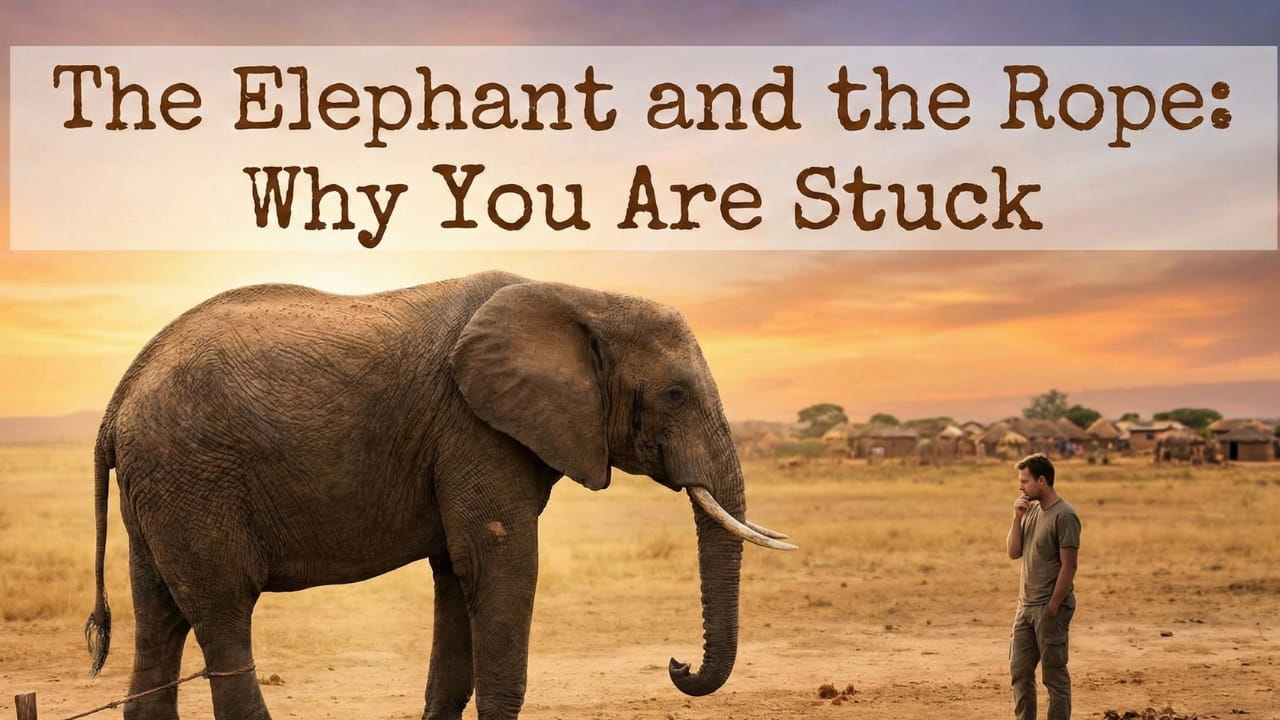
Restraining this five-ton leviathan was a single, small piece of rope.
One end was tied loosely around Titan’s front left leg. The other was knotted to a small, weathered wooden stake driven maybe a foot into the soft mud. The rope itself looked old and fraying—something you might use to tie up a bundle of newspapers, not hold back a living tank.
Elias stared. The physics didn't make sense. It was laughable. Titan could snap that rope with a casual twitch of his ankle. He could pull that stake out of the ground without even noticing the resistance. He could walk away into the jungle right now. He could be free in seconds.
But Titan didn't move.
He stood there, swaying gently, chewing on a branch, accepting the radius of the rope as his absolute reality. He didn't pull. He didn't struggle. He didn't test the boundary. To him, that thin piece of hemp was an unbreakable wall.
"It’s a trick," Elias muttered to himself. "Maybe he's trained not to move? Maybe he's sick?"
The History of the Hold
Unable to reconcile what he was seeing, Elias flagged down a passing trainer, an older man named Kiet with deep laugh lines around his eyes and hands stained with turmeric and soil.
"Excuse me," Elias said, pointing at the beast. "I don't mean to be rude, but... is that safe? That animal is powerful enough to flip a truck. That rope is... well, it's a joke. Why doesn't he just break it and walk away?"
Kiet stopped and looked at Titan with a gaze full of affection and sadness. He chuckled softly. "I know. It looks strange to you. You see a giant. But I don't see a giant. I remember him when he was very small."
Kiet leaned against the wooden fence, crossing his arms. "When Titan was a baby, just a few months old, he was much smaller and much weaker. In those days, we used the exact same size rope to tie him."
He gestured to the rope. "Back then, at that age, the rope was enough. It was stronger than he was. The baby Titan would pull and pull. He would tug and scream. He would try with all his might to break away to find his mother, but the rope held firm. The stake didn't budge."
Elias listened, the noise of the jungle fading into the background.
"Every day for his first few years," Kiet continued, "he fought the rope and lost. He fought, and the rope won. Eventually, his brain formed a rule: The rope is unbreakable. I am not strong enough."
Kiet looked back at Elias. "Now, he is five tons. He is a mountain. But in his mind? He is still that small, weak baby. He believes the rope can still hold him, so he never tries to break it. He is trapped not by the rope, but by his memory."
The Invisible Prison of "Learned Helplessness"
Elias felt a chill run down his spine that had nothing to do with the breeze. He wasn't looking at an elephant anymore. He was looking at himself.
Titan was a prisoner of his past. Psychologists call this Learned Helplessness. It happens when we experience failure or limitation repeatedly, until we stop trying to change our circumstances—even when the circumstances change completely.
The barrier wasn't physical. It was entirely mental. The elephant had the power, but he lacked the belief. He had accepted a limit that was no longer real.
Elias thought about his own life. He thought about the novel he stopped writing because a teacher criticized him in 10th grade. That was a rope. He thought about the business idea he never launched because he failed at a lemonade stand when he was twelve. That was a rope. He thought about his fear of public speaking, rooted in one awkward moment years ago. A tiny, fraying rope.
The Moral: Test Your Ropes
We are all walking around with ropes tied to our legs. We have beliefs about what we can't do, simply because we couldn't do them yesterday, or ten years ago.
Maybe you tried to get fit and failed, so now you believe "I'm just not an athletic person." Maybe you tried to learn to code and got confused, so now you believe "I'm not smart enough for tech."
But here is the truth: You are not the same person you were when you first failed. You have grown. You have more resources, more wisdom, and more strength. The rope hasn't changed, but you have.
- Audit Your Beliefs: Ask yourself: "Is this true, or is this just a memory of a past failure?"
- One Tug is All it Takes: The only way to know if the rope is still strong is to pull on it. Test your limits again. Apply for the job. Write the page. Run the mile.
- Don't Be Titan: Don't let a thin string hold back your massive potential. The stake is loose. The rope is old. You are powerful.
Break the rope. You are free.