Imagine for a moment that you are the CEO of the biggest company on the planet. Every single minute of your day is accounted for. People are constantly pitching you ideas, lawyers are handing you lawsuits, and engineers are asking for direction. Your brain is a superhighway of information, traffic-jammed with noise.
How do you find the mental space to see the future?
If you are Bill Gates in the 1990s, you don't try to find space in your calendar. You run away.
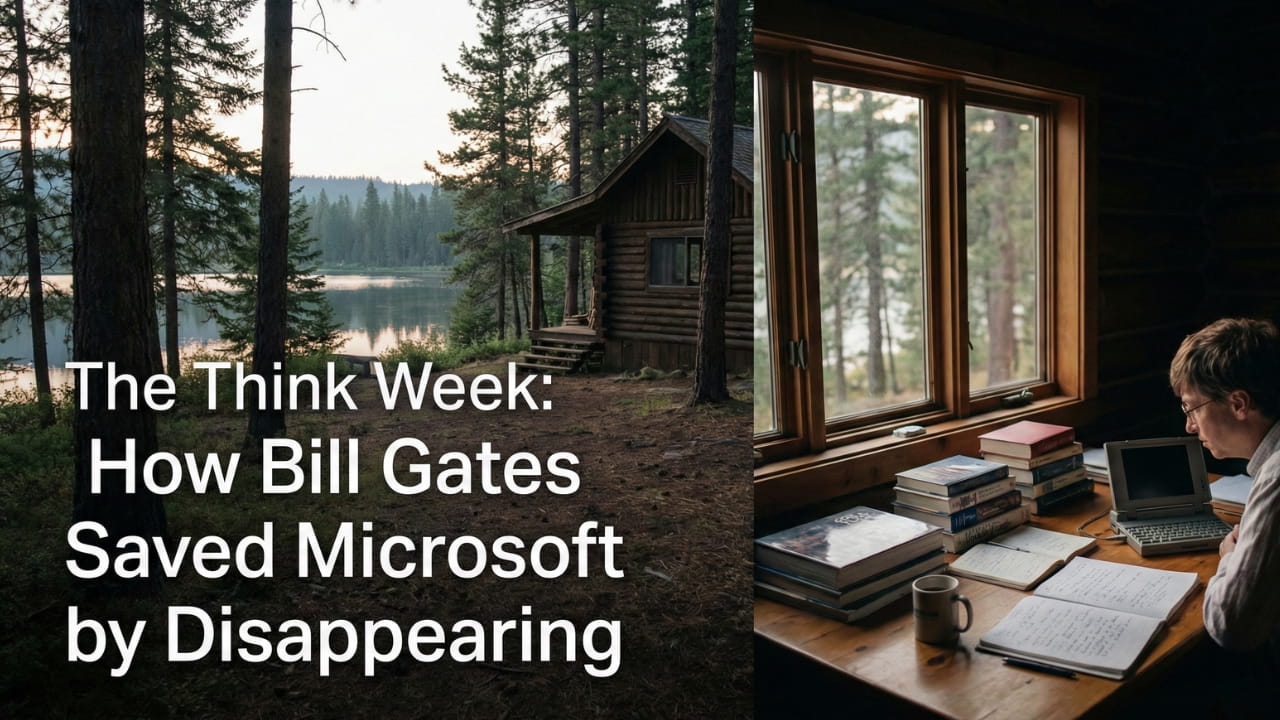
Twice a year, Bill Gates would perform a ritual that baffled his employees and peers. He would pack a large canvas bag with books, scientific papers, and investment proposals. He would get on a helicopter or a seaplane and fly to a secluded, secret cabin in the Pacific Northwest.
He called it "Think Week." For seven days, he was completely off the grid. No internet (ironic for a tech giant). No phone calls. No family. No employees. Just Bill, a stack of papers, and a fridge full of Diet Coke.
The Tsunami He Saw Coming
It sounds like a vacation, but it wasn't. It was an intellectual ultra-marathon.
We often confuse "being busy" with "being productive." We check emails, attend meetings, and feel important. But Gates knew that busy-ness is the enemy of strategy. If you are always reacting to what is happening now, you can never prepare for what is happening next.
The proof is in history. In 1995, Microsoft was the king of the desktop computer. Windows 95 was about to launch. But there was a new, tiny competitor called Netscape that was betting everything on something called "the Internet."
At Microsoft HQ, the executives were dismissive. They thought the internet was a fad, a toy for academics. They were too busy maximizing Windows profits to care.
But Bill took a stack of papers about the internet to his cabin. In the silence of the woods, away from the echo chamber of his office, he read. He thought. He connected the dots. He realized that the internet wasn't just a toy; it was a tidal wave that would wipe out any company that ignored it.
He sat down and wrote a memo that is now legendary: "The Internet Tidal Wave."
He returned to the office and pivoted the entire company. Every product, every team, every strategy was realigned to focus on the web. That pivot saved Microsoft. Without that quiet week in the woods, Microsoft might have become another Blockbuster or Kodak.
Why Your Brain Needs Boredom
Why did he need a cabin? Why couldn't he just close his office door?
The answer lies in how our brains work. Neuroscientists distinguish between "linear thinking" (following a recipe) and "lateral thinking" (connecting unrelated ideas). Linear thinking happens when you are focused and busy. Lateral thinking—creativity—happens when your brain is idle, relaxed, or bored.
In our modern world, we have murdered boredom. If we have 30 seconds in an elevator, we pull out our phones. If we are waiting for a coffee, we check Instagram. We constantly stuff information in, so nothing original ever comes out.
By isolating himself, Gates removed the "inputs." When you stop feeding your brain junk, it starts to digest the high-quality information you've given it. It starts to synthesize. It starts to see patterns.
How to Run Your Own "Think Week" (Without a Helicopter)
You probably aren't a billionaire. You probably have a boss who expects you to answer emails, or kids who need to be fed. You can't just disappear into the woods for a week.
But you don't need a week. You just need the *principle*. Here is how to apply the "Think Week" blueprint to a normal life:
1. The "Think Day" (Quarterly)
Once every three months, take a vacation day or use a Saturday. Do not stay home where the laundry will distract you. Go to a library, a quiet coffee shop in the next town, or rent a cheap motel room.
The Rules:
- Phone off (not silent, OFF).
- No email. No social media.
- Bring a notebook and a pen.
- The Goal: Answer one big question. "Am I happy in my career?" "How can I
double my income?" "What is the biggest bottleneck in my life?"
2. The "Digital Sabbath" (Weekly)
Pick one day a week (Saturday or Sunday) where you go offline. No screens. Go for a walk, cook, read a physical book. Give your subconscious mind 24 hours to breathe. You will be amazed at the ideas that pop into your head on Monday morning.
3. The "No-Meeting" Morning
If a whole day is too much, steal two hours. Block out 8:00 AM to 10:00 AM on your calendar every day. Mark it as "Strategy." Treat this time as sacred. Do not open your email until 10:01 AM. Use your freshest mental energy for your hardest work, not for replying to other people's requests.
The Final Lesson
We are often afraid of silence because in the silence, we have to face ourselves. We have to face the difficult questions we've been hiding from with our busy-ness. But that is exactly where the gold is buried.
- Busy is the Enemy: Being busy is often a form of laziness—lazy thinking and indiscriminate action.
- Inputs Determine Outputs: If you consume the same noise as everyone else (social media, news), you will think the same thoughts as everyone else. To think differently, you must consume differently.
- Retreat to Advance: Sometimes, the best way to move forward is to stop moving entirely.
The next time you feel overwhelmed, don't work harder. Stop. Disappear. And think.